
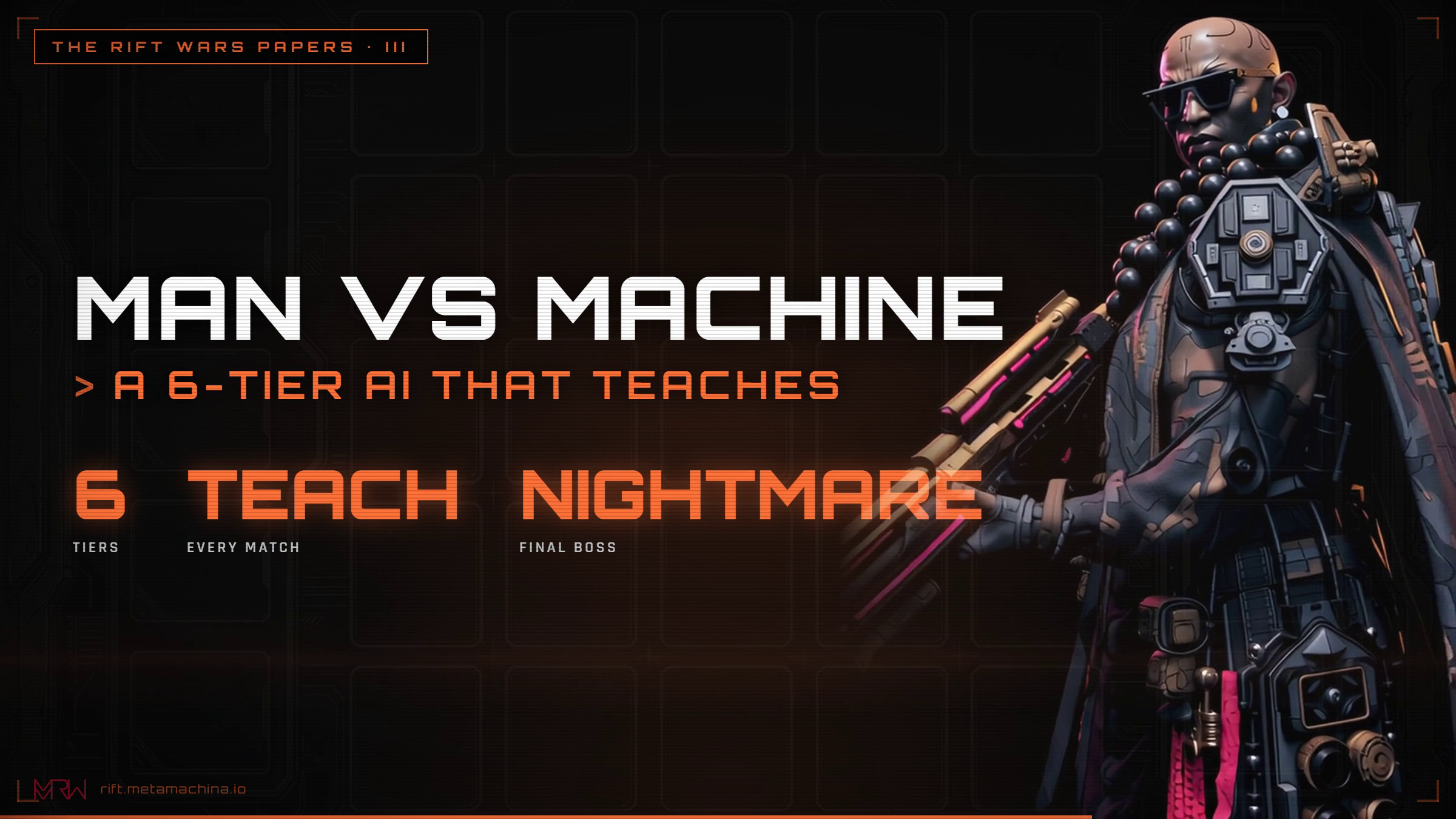
Man vs Machine
By 1DigitalC — The Rift Wars Papers, Part III: The Infrastructure
Every game has bots. Most of them are terrible. And nobody talks about why that matters, because the industry treats AI opponents like a checkbox instead of a feature.
I've been playing competitive games since before matchmaking existed. Back when you hosted your own servers, picked your own lobbies, and if nobody was online at 2am, you just didn't play. We accepted that. But the modern player doesn't, and shouldn't have to.
Here's the problem nobody wants to say out loud: your game is dead every minute a player can't find a match.
The Queue Time Problem
Every multiplayer game lives and dies by one metric that never shows up in pitch decks: time-to-match. How long does a player wait between pressing "Play" and actually playing?
Industry data tells us the window is brutally small. Research from Riot Games and internal studies across competitive titles consistently show that player tolerance for queue times drops off a cliff after 60 seconds. By 2 minutes, a significant percentage of players cancel the queue. By 5 minutes, you've lost them. Not just for that session, but permanently.
For a new game without millions of concurrent users, this is a death sentence. You launch. You have 500 players spread across 24 time zones. At any given moment, maybe 15 are looking for a match. The queue takes 3 minutes. Half of them leave. Tomorrow they don't come back. Your player count drops to 300. Queue times get longer. The spiral accelerates.
This is how games die. Not from bad gameplay. Not from bugs. From an empty lobby.
The Bot Excuse
So the obvious answer is bots. Every game studio knows this. And in most cases, studios treat it like an embarrassment. Something you hide, something you apologize for. "We have bots while the player base grows." As if AI opponents are a placeholder for real humans rather than a feature in their own right.
That mindset is backwards.
Look at the games that have lasted decades. Chess has been played against computers since 1997 and nobody considers that a lesser experience. Fighting games have training mode AI that competitive players use to lab combos for hundreds of hours. Even Pokémon, one of the highest-grossing franchises in history, is fundamentally a single-player game against AI trainers.
The problem isn't that games have bots. The problem is that most bots are garbage.
They're either so brain-dead that beating them teaches you nothing, or so brutally overtuned that fighting them feels like hitting a wall. Neither makes you a better player. Neither is fun. And when your game's only option at 2am is a bot that plays like a drunk toddler or a bot that plays like it has read access to your hand — players close the tab.
Building AI That Teaches
When I started building the bot system for Rift Wars, I had one principle: every tier should teach you something.
Not "make easy bots for bad players and hard bots for good players." That's lazy. Every difficulty level should develop a specific skill. The progression through bot tiers should feel like a curriculum, not just a slider from "braindead" to "unfair."
Here's what that looks like in practice:
Recruit plays simple. It places cards where it has crystals, prioritizes filling the board, doesn't think about your grid at all. What does it teach? Board awareness. You learn to read your own card grids, understand crystal placement, and figure out the basic flow of a match without being punished for mistakes. It's fundamentals.
Operative starts considering row scoring. It tries to win rows, not just fill tiles. It starts to focus placement. What does it teach? Strategic intent. You learn that placement isn't random — it's purposeful. You start thinking about which rows to contest and which to concede.
Commander evaluates ability interactions. It places destroy cards where your high-value targets sit. It uses boost strategically. What does it teach? Reading the board from your opponent's perspective. You start seeing threats before they materialize. You start placing defensively when you need to.
Apex is where it shifts. Apex has limited visibility into your hand. It can see 2 of your cards. It uses that information to predict your next move and counter it. It reads your patterns across the match. If you always open with a cost-1 card in the center column, Apex notices. If you tend to stack one row and abandon another, Apex punishes that.
What does it teach? That you have patterns, and good opponents exploit them. This is the tier where players start to get uncomfortable, because Apex holds up a mirror.
Master sees more of your hand and analyzes your deck composition. It makes reads based on what cards you've already played versus what's statistically likely to be left. It plays the odds.
Nightmare sees everything. Full information. It's not meant to be fair — it's meant to be a wall. The question isn't whether you can beat it. The question is whether you can find a line through perfect play.
Why This Matters More Than You Think
Here's what I've observed after watching players progress through bot tiers: the ones who grind through all six tiers before entering ranked play outperform the ones who jump straight to PvP.
And it's not close.
The bot tiers aren't a substitute for human competition. They're preparation for it. A player who's beaten Apex has already confronted their own habits, already learned to vary their openings, already developed the reflex to read ability grids before placing. They enter ranked with fundamentals that take pure-PvP players weeks to develop.
This is the part the industry gets wrong. Bots aren't the fallback when humans aren't available. Bots are the training ground that makes human competition better. Every martial art has forms you practice alone before you spar. Every musician practices scales before they perform. Games should work the same way.
The 2am Test
I call it the 2am test. If a player opens your game at 2am in a timezone where nobody else is playing, do they have a meaningful experience?
If the answer is "they sit in a queue for 5 minutes and close the tab," your game fails the test. It doesn't matter how good your gameplay is. It doesn't matter how balanced your cards are. If there's nobody to play against and no AI worth fighting, the player leaves. And every time they leave, the probability of them coming back drops.
Rift Wars passes the 2am test. At any hour, any timezone, a player can launch the game and immediately fight an AI opponent calibrated to their skill level. No queue. No waiting. No empty lobby. The bot is ready the moment you are.
And here's the part that matters: that bot match still teaches them something. It still has strategic depth. It still prepares them for ranked. It's not a consolation prize. It's part of the game.
The Future of Man vs Machine
We're entering an era where AI in games won't just be difficulty tiers. It'll be adaptive opponents that evolve with each player individually. Opponents that remember your tendencies across sessions. Opponents that develop their own meta based on how the entire player base plays.
Some of that is already happening in Rift Wars at the higher tiers. But the potential goes further than any single game.
Imagine a training AI that identifies your three biggest weaknesses and constructs matches specifically designed to expose them. Not to punish you — to teach you. An AI that sees you always neglect the bottom row and forces you to contest it until you develop the habit. An AI that notices you never play hidden cards and creates board states where hidden cards are the optimal play.
That's not science fiction. That's the direction.
The question for every game developer should be: are your bots making your players better? Or are they just filling empty chairs?
If your game needs humans to exist before it's worth opening, it's fragile. If it works without them — if the experience holds up at 2am with zero players online — it scales.
If your AI isn't teaching, it's wasting everyone's time.
This is how I think. This is what I'm building. If that resonates, you'll understand the game.