
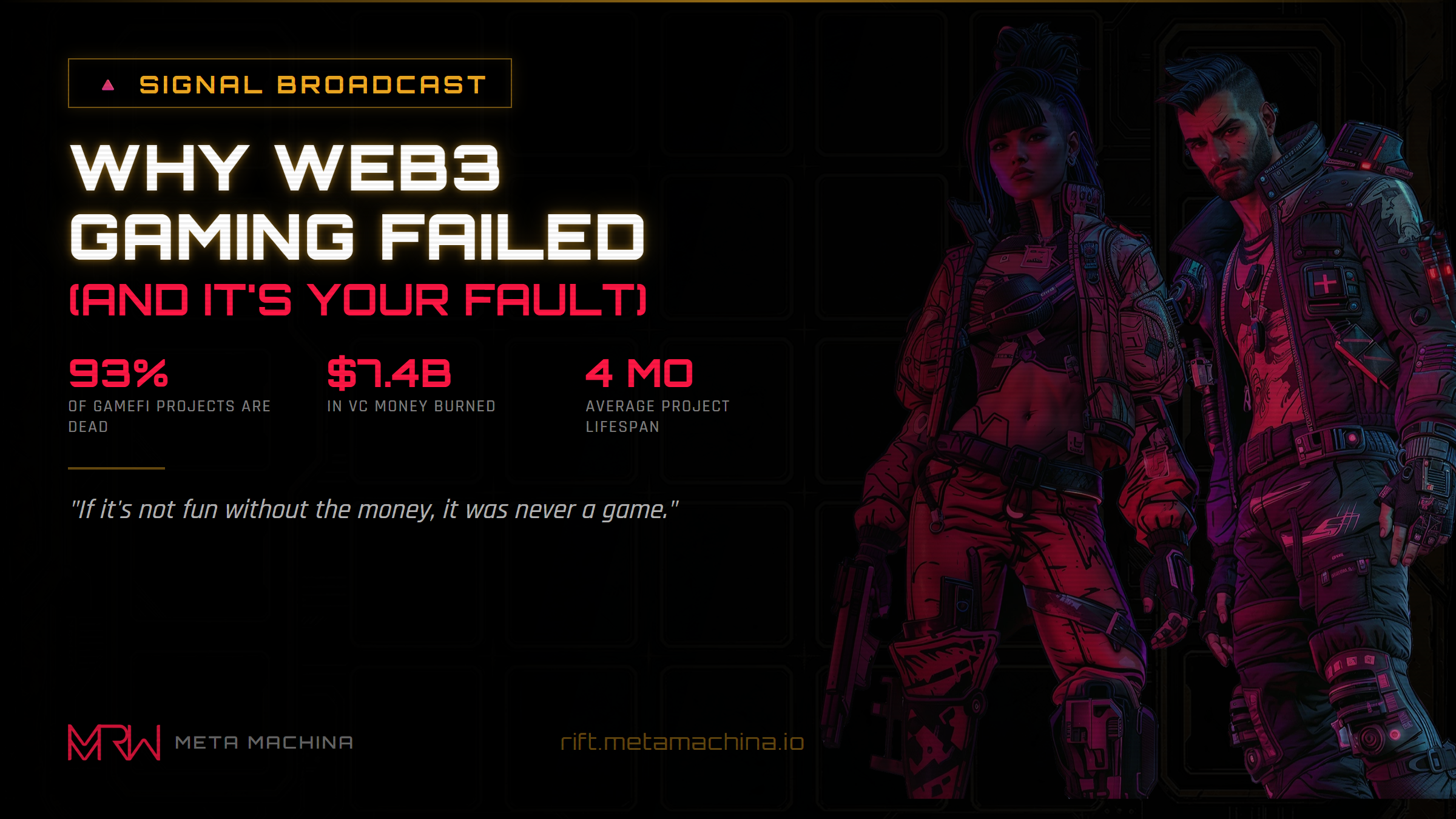
Why Web3 Gaming Failed (And It's Your Fault)
The Rift Wars Papers — Part I: The Diagnosis
By Patrick — Solo Dev, Rift Wars / Meta Machina
Let me save you the suspense: web3 gaming is in a coma, and the people screaming loudest about saving it are the same ones who put it there.
I've been in blockchain since 2016. I've been gaming since before most of you were born — Guild Wars, EverQuest, EVE Online, Conquer Online, Phantasy Star Online on the Dreamcast. I've run top guilds. I've seen what makes games last a decade and what makes them die in a week. And I'm telling you right now — web3 gaming didn't fail because the tech is bad. It failed because everyone involved chose money over gameplay, and then acted surprised when the house of cards collapsed.
I've got receipts. Let's go.
The Fatal Flaw: Economy First, Game Never
Here's where it all went sideways. The vast majority of web3 games launched the same way: token first, game second. Sometimes game never.
The playbook was always the same. Raise money on a token. Hype the whitepaper. Hire some developers off Fiverr. Push out something that barely qualifies as a game. Cash out. Wipe your hands. Move on to the next one.
And the numbers prove it. ChainPlay's 2025 annual report confirmed what we already knew: 93% of GameFi projects are dead — token price down 90%+ from all-time high with fewer than 100 daily active users. A separate CoinGecko study using stricter criteria still puts the number at 75% — three out of four projects, gone. The average GameFi project lifespan? Four months. Not four years. Four months.
Let that sink in. The entire "industry" was running on a four-month life expectancy. That's not game development. That's a pump and dump with a loading screen.
CoinGecko analyzed 2,817 web3 games launched between 2018 and 2023. In 2022 alone, 742 games collapsed — a failure rate of 107%, meaning more projects died that year than were even launched. Games from previous years were still falling apart.
And these weren't underfunded experiments. From 2020 to 2022, VCs poured over $7.4 billion into web3 gaming. Billions. Where did it go? Into tokens that lost 95% of their value on average. Into games that never shipped. Into teams that dissolved the moment the bear market hit.
And it's still getting worse. The total GameFi market cap collapsed 67% in 2025 — from $23.87 billion down to $7.8 billion. VC funding dropped to $544 million in 2025, down from $857 million the year before. 89% of investors reported declining profits. 62% lost more than half their returns.
The money is leaving because the results were never there.
The Pattern: A Story Told a Thousand Times
I'm not here to drag specific projects. You already know their names. But let's look at the pattern because it played out the same way everywhere.
A play-to-earn game launches a token. It promises the world — "next-gen" this, "revolutionary" that. At peak hype, millions of daily active users flood in, some titles generating hundreds of millions in monthly revenue. Then the token drops. Players leave overnight — over a million gone in a single month in some cases. Within a year, user counts crater 55-75%. The token loses 99% of its value. The "revolution" lasted about 12 months.
Or a team raises tens of millions and promises a AAA-quality MMO. Token peaks at launch and drops 99%+. Years later, key features are still in demo stage. Some of these projects are genuinely still building — and respect to the ones that are — but the token holders who bought the hype have been underwater for years, and the game they were promised still isn't the game that exists.
Or a project raises $65 million across multiple funding rounds and takes years to reach open beta — burning through runway while token holders watch their investment evaporate. Sixty-five million dollars and counting.
And those are the big ones — the ones with real teams and real money behind them. For every one of those, there were a hundred nameless farming simulators with missing pixels and seven vegetables to plant. Going on nine months planting the same carrots in the same spot — that was someone's "game." That was someone's "investment."
I don't even think it's gaming anymore at that point. It's wash trading and money laundering wearing a game's skin.
The Culture That Killed It
The culture problem is just as bad as the tech problem.
An analysis of 60+ web3 games found that 40% of users in most web3 games are bots. One project had 84% bot users. Those "impressive" daily active wallet numbers? A massive chunk of them aren't human beings. They're automated wallets farming airdrops and inflating metrics. Even now, DappRadar reports 4.66 million daily active wallets in Q3 2025 — a number that's been essentially flat year-over-year while the overall market shrinks around it. How many of those wallets are real people playing a game they enjoy? Nobody can tell you.
On crypto Twitter, it's worse. Research from Blockworks showed that cryptos with bot-inflated engagement on Twitter actually yielded lower returns — the bots pump visibility, but real users aren't behind the numbers. The whole engagement layer is theater.
Meanwhile, web2 gamers — the actual market you need to win — want nothing to do with any of this. A survey of nearly 7,000 gamers rated their feelings toward crypto at 4.5 out of 10 and NFTs at 4.3 out of 10. Only 3% of gamers own an NFT. Only 12% had even tried a web3 game. As of late 2025, overall sentiment toward NFTs in gaming is described as "slightly negative, moving toward neutral" — which, after five years and billions of dollars, is a damning progress report.
And you know what? They're right to be skeptical. When 70% of game developers say they're not interested in crypto and 72% say they're not interested in NFTs — per the Game Developers Conference's own survey of 2,700+ developers — that tells you something. The people who actually build games looked at web3 gaming and said "no thanks."
Steam banned all blockchain games in October 2021 and that ban is still in effect today. The largest PC gaming platform on Earth looked at the space and closed the door. A few web3-adjacent titles have found ways onto Steam by making their blockchain elements entirely optional — but the policy hasn't changed. The message is clear.
The Accountability Mirror
Here's the part nobody wants to hear.
If you bought a token for a game that didn't exist yet — you are the problem.
If you put your life savings into some crypto farming simulator because a Twitter thread told you it was going to 100x — that's on you. If you're nine months deep planting digital carrots in a game with seven assets and you're wondering why the token went to zero — take a look in the mirror.
The audacity of web3 gaming culture is wild. Imagine watching Netflix for 90 minutes and then asking "when do I get paid?" That's what web3 did to gaming. It turned entertainment into an extraction game. People won't even beta test now without an on-chain incentive. You could literally pay people to play web3 games and they won't do it.
And look — most people didn't set out to destroy the space. The system was designed to reward this behavior. Tokenomics incentivized speculation over gameplay. Marketing rewarded hype over substance. If every project around you is launching tokens before games and getting funded for it, of course people followed the pattern. That doesn't make it right, but it explains why it happened at scale.
Crypto was supposed to be about sovereignty. Decentralization. Owning your digital life. Instead, the space got infiltrated during COVID by people who only saw dollar signs. The gold rush attracted the worst kind of builders — the ones who never intended to build anything at all.
And the community enables it. There are a handful of genuinely good web3 games out there right now — games with real studios, real gameplay, real effort behind them. Some have millions of registered players and still struggle to get meaningful engagement on their social posts. The whole community is lucky those games exist, and they can't even be bothered to support them. But some random meme token game posts a "roadmap" image and gets 500 retweets — 490 of which are bots.
So Now What?
That's the diagnosis. The data is clear. The pattern is documented. The culture enabled it. And yes — a lot of us were complicit, whether we built the wrong thing, funded the wrong thing, or just looked the other way.
The question is what "building right" actually looks like — because "make a better game" isn't specific enough. The space needs a real framework, not another motivational thread.
That's what we're breaking down next.
If it's not fun without the money, it was never a game.
This is how I think. This is what I'm building. If that resonates, you'll understand the game.
Rift Wars | @MetaMachina_RW | Discord
Sources
- ChainPlay — GameFi Statistics 2025 Annual Report
- CoinGecko — "Is GameFi Dead? 3 in 4 Projects Have Failed"
- GamesBeat — "Blockchain Gaming Market Value Plunged 67% in 2025"
- CoinGecko — Web3 Game Failure Analysis (2,817 games)
- InvestGame — Web3 Gaming Investments 2020-2024
- DappRadar — State of Blockchain Gaming Q3 2025
- Play-to-Earn Player Collapse Data
- Peak P2E Monthly Revenue
- Token Price Collapse — 99%+ Decline Pattern
- Web3 Game Bots — 40% of Users
- Crypto Twitter Bot Impact on Returns
- Gamer Sentiment Survey (n=6,921)
- Only 3% of Gamers Own an NFT
- NFT Gaming Sentiment October 2025
- GDC Developer Survey — 70% Not Interested in Crypto
- Steam Blockchain Game Ban (2021, still active)
- Web3 Games Still Launching on Steam Despite Ban