
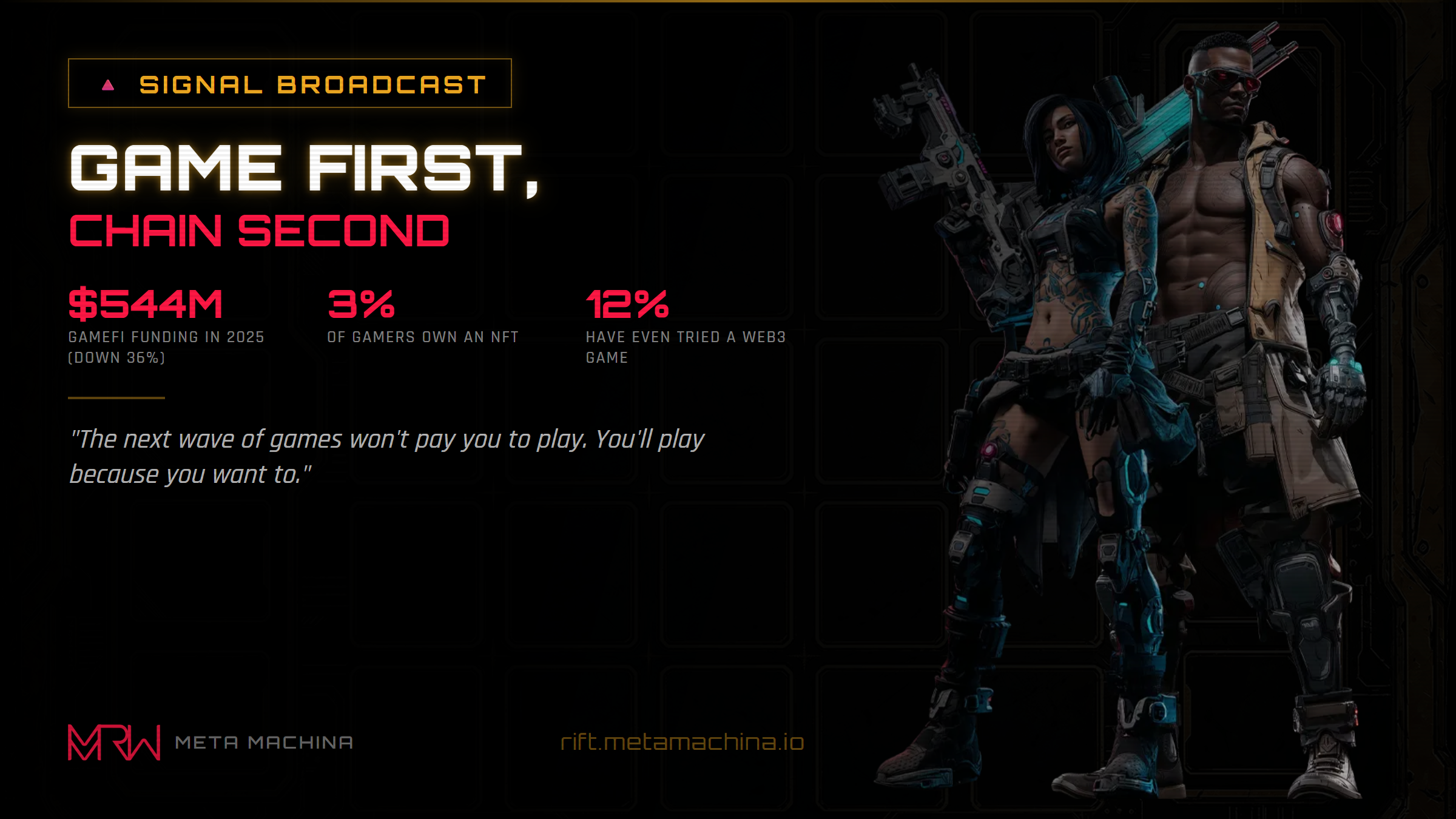
Game First, Chain Second
The Rift Wars Papers, Part II: The Framework
By 1DigitalC, Solo Dev, Rift Wars / Meta Machina
In our last article, we laid out why web3 gaming failed. The data, the pattern, the culture that enabled it. 93% of projects dead. $7.4 billion in VC money burned. Four-month average lifespan. If you haven't read it, start there.
This one is about what comes after.
Because "support real builders" isn't enough. Everyone says that. It's a bumper sticker, not a blueprint. The space doesn't need more cheerleading. It needs specifics. What does building right actually look like? What separates a game that lasts from a game that dies the moment the token drops?
I've spent the last year building Meta Machina FPS solo. No VC money. No token. No Fiverr team. Just the work. And through that process, I've arrived at a set of principles that I think the space needs to hear. Not because I have all the answers, but because almost nobody is even asking the right questions.
Build the Game Before You Build the Economy
This should be obvious. It isn't. Because most teams aren't building games. They're building exits.
The overwhelming majority of web3 games launched their token before their gameplay was ready. Some launched tokens before a game existed at all. And then everyone acted surprised when players treated it like a financial instrument instead of entertainment.
If the economy is the first thing you build, it becomes the only thing players care about. And the moment that economy stops being profitable, and it always does, they leave. Not because the game got worse. Because the game was never the point.
Build something people want to play without a financial incentive. Then layer in the economy. Not the other way around. The economy should enhance a loop that already works, not be the loop.
The things that kept people playing Counter-Strike for 25 years or Magic: The Gathering for 30 weren't tokens. They were strategy. Competition. Mastery. Community. If your game can't retain players when the token is worth zero, you don't have a game. You have a countdown timer.
Reward Participation, Not Purchasing Power
Here's where most web3 games reveal what they actually are.
If the primary way to progress in your game is spending money, you haven't built a game. You've built an extraction system aimed at whales. And the data shows exactly where that leads: a small group of high-spenders propping up metrics while everyone else quietly leaves.
Reward players for playing. For competing. For improving. For contributing to the community. Not for having the deepest pockets. The moment you build a system where spending more money directly translates to winning more games, you've built a casino with extra steps. And you've told every skilled player that their time doesn't matter.
Incentives should be tied to participation, not purchasing power. That's not idealism. That's retention math. The players who stay longest are the ones who feel like their investment of time is respected, not just their investment of money.
Design Systems That Can't Be Whaled
If one person can spend $10,000 and dominate everyone in the lobby, your game is dead on arrival. You just haven't realized it yet.
Whales might fund your first month. They might make your revenue chart look impressive in a pitch deck. But they destroy retention for everyone else. And once the non-whales leave, and they will, the whales leave too. Because there's nobody left to beat.
This is the part most web3 game designers refuse to confront: the short-term revenue from whale-friendly mechanics directly kills the long-term health of the game. Every dollar a whale spends to win is a player you lose who was never going to spend that much.
Design systems where skill and strategy matter more than wallet size. Build balance that prevents any single card, item, or asset from being an auto-win regardless of rarity. If a player can stack all legendaries in a deck and dominate, your balance is broken and your game has a shelf life measured in weeks.
Make It Accessible. Actually Accessible.
If your web3 game costs $500 to play, why the hell would anyone join?
Traditional gamers already complain about $60 titles, and those come with full campaigns, multiplayer, years of updates. Now you want someone to buy a several-hundred-dollar NFT just to experience your game? Before they even know if they like it?
And it's not just western markets you're pricing out. You're locking out entire regions of the world. Players in Southeast Asia, South America, Africa, many of the same communities that drove the early play-to-earn boom, can't afford to spend $100 on a browser game. You've taken the one audience that was genuinely excited about web3 gaming and put a velvet rope in front of them.
Free-to-play isn't charity. It's the only entry point that makes sense if you actually want people to play. Lower the barrier. Let people in. A player who joins for free and stays for six months is worth infinitely more than a whale who spends $500 and leaves in two weeks.
Blockchain Should Be Infrastructure, Not a Gate
The first question a player asks should be "is this fun?" Not "which chain is this on?" Not "do I need a wallet?"
If someone needs to set up a crypto wallet, buy tokens on an exchange, bridge to the right chain, and connect to your dApp just to try the game, you've already lost 95% of potential players before they see a loading screen. That's not an exaggeration. Only 12% of non-crypto gamers have ever tried a web3 game, and only 15% of those who haven't expressed any interest. Every wallet prompt, every chain selection, every bridge transaction is another door you're asking someone to walk through before they even know if they want to be in the building.
The web3 games that are actually surviving right now share one thing in common: they treat blockchain as optional back-end infrastructure. You can play the game without ever touching a wallet. The on-chain elements are there for the players who want them, but they're not a prerequisite. That's not a compromise. That's how you build a player base that isn't limited to the 3% of gamers who already own an NFT.
The Teams Still Standing
Here's the reality of building in this space right now.
VCs are pulling back. Web3 gaming raised just $91 million in Q1 2025, then $73 million in Q2 2025, a 93% year-over-year collapse. The total GameFi market cap has cratered from $23.87 billion at the end of 2024 to $4.70 billion in May 2026. An 80% wipeout in seventeen months. The money isn't just drying up. It's evaporating.
Web2 gamers don't trust the space. Web3 degens only care about the token. Developers don't want to be associated with the label. for the first time in years, GDC 2026 had zero blockchain gaming sessions on the schedule. The booths are gone. AI companies replaced them. Platforms ban you. The press writes you off.
And yet, some teams are still building. Still shipping updates. Still trying to prove that blockchain can enhance gaming without replacing it. Those teams deserve your attention more than any new whitepaper, any new mint, any new "revolutionary ecosystem" announcement.
Every time the community ignores a real game to chase a meme token, it proves the critics right. And every time someone plays a web3 game because it's actually fun, not because they're farming an airdrop, it proves something different.
"So Why Is a Game Studio Publishing This?"
Yeah, this is coming from a game studio. Rift Wars is a card game. Meta Machina is the studio behind it. We have skin in this space. That's exactly why we're saying it.
We're not pretending this isn't marketing. Of course it is. Every time a builder opens their mouth in public, it's marketing. The difference is whether you're marketing hype or marketing a position. We're choosing the position.
Rift Wars isn't trying to be just another web3 game. Meta Machina is striving to be a digital culture. And to build a culture, you have to accept the truth about the world you're operating in. You have to study the past. You have to make sure your community understands not just the game they're playing, but the space they're entering.
We're not going to pretend everything is fine. We're not going to tell you web3 gaming is thriving when 93% of projects are dead and the market cap has lost 80% of its value in seventeen months, from $23.87 billion to $4.70 billion. We're not going to hype a token when the data says tokens kill games. That's not how you build trust, and it's not how you build something that lasts.
Educated players are more intelligent players. Intelligent players are better players. And in a game like Rift Wars, where strategy, deck building, and outsmarting your opponent is everything, that all adds up. We don't want a community that buys in blind. We want players who understand what they're part of, why the space is broken, and what it actually takes to build something worth playing.
If you're a builder in web3 gaming right now, keep going. The space needs you more than it needs another whitepaper.
And if you're a player, stop rewarding the grifters. Find the builders. Play their games. Give them feedback. Be the community that web3 gaming was supposed to have from the start.
The next wave of games won't pay you to play. You'll play because you want to.
This is how I think. This is what I'm building. If that resonates, you'll understand the game.
Previous: Why Web3 Gaming Failed (And It's Your Fault)
Next: Man vs Machine, Why your bots matter more than your players.
Sources
- ChainPlay: GameFi Statistics 2025 Annual Report
- CoinGecko: Gaming (GameFi) Market Cap (live, May 2026)
- DappRadar: State of Blockchain Gaming Q2 2025
- Gamer Sentiment Survey (n=6,921)
- Web3 Gaming Adoption Survey, Cointelegraph
- Web3 Gaming Funding Collapse Q1-Q2 2025, CCN
- GDC 2026: Zero Blockchain Gaming Sessions, PC Gamer